Contact Us
Navi Mumbai Airport Goes 24/7: What It Means for Ulwe and Panvel in 2026
The airport is no longer a “someday” story
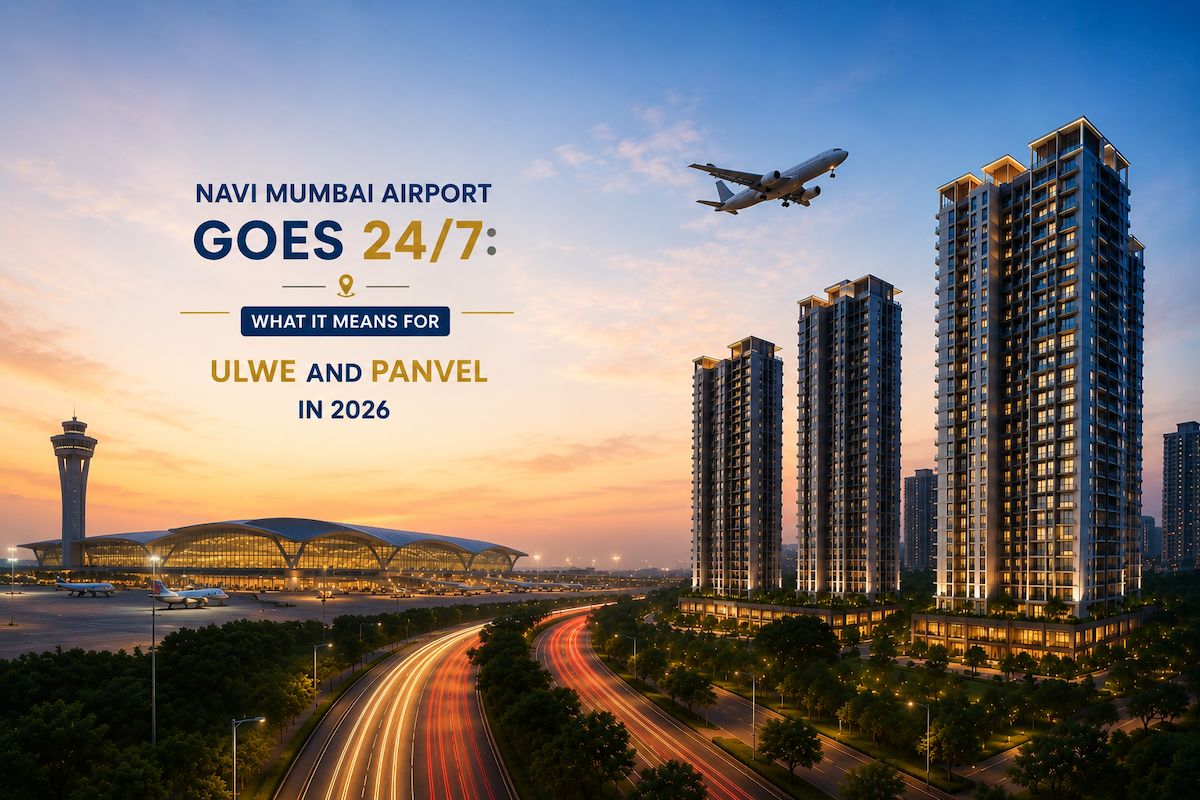
For years, every conversation about buying property near the Navi Mumbai International Airport started with a caveat: it’s coming, but nobody knows exactly when. That caveat is gone. NMIA opened for commercial flights on December 25, 2025, and by February 2026 it had moved to round-the-clock operations, with major domestic carriers steadily adding daily departures through the year. For homebuyers and investors who were waiting for proof before committing, this is that proof.
Why this matters more for Ulwe and Panvel than anywhere else
Every node in Navi Mumbai benefits from the airport in some way, but Ulwe and Panvel sit closest to the terminal and to the Atal Setu (Mumbai Trans Harbour Link), which has already cut travel time to South Mumbai dramatically. That combination – shortest commute to the airport, and a direct road link to the city’s business districts – is exactly what turns an infrastructure announcement into sustained price movement rather than a short-lived bump.
Ulwe has led this cycle so far, with steady appreciation as the airport moved through its opening phases. Panvel, sitting slightly further out but with more established social infrastructure – schools, hospitals, the railway station, and a longer track record of completed projects – has moved more gradually, which is exactly why it still has room that Ulwe’s more mature pricing doesn’t.
Ulwe vs. Panvel: which one fits your goal?
This isn’t a question with one right answer – it depends on what you’re optimising for.
- If you want maximum long-term upside and are comfortable with a newer, still-developing social ecosystem, Ulwe’s proximity to the terminal and the Aerocity business district gives it the stronger growth story.
- If you want a more immediate, liveable neighbourhood today – established markets, schools, and connectivity that doesn’t depend on future phases completing – Panvel is the steadier choice, and current entry prices still sit below what Ulwe commands for comparable configurations.
We’ve laid out this comparison in more depth on our dedicated Ulwe vs. Panvel guide, including how each node scores on connectivity, price trajectory, and readiness for immediate possession.
What actually changes for a buyer right now
Three things are worth acting on in 2026 rather than waiting on:
- Rental demand is shifting. As the airport ramps up staffing across aviation, logistics, and the emerging Aerocity commercial zone, rental tenants increasingly want a short commute to work – not just a scenic view of construction.
- Loan eligibility and bank comfort with these micro-markets has improved noticeably now that the airport is operational rather than “planned,” which shows up in smoother approvals and better rate negotiations.
- RERA-registered, delivery-ready inventory in both nodes is getting absorbed faster than new launches can replace it – the window to choose from multiple ready or near-ready options is narrower than it was even six months ago.
Where TPV Vishwakarma fits
Bharat Enclave in New Panvel gives buyers 2 & 3 BHK configurations in a location that already benefits from the airport-driven demand wave without carrying Ulwe’s premium pricing. For those set on the Ulwe corridor specifically, our investment guide walks through what to check – RERA status, builder track record, and realistic possession timelines – before committing capital to a still-developing node.
The airport question has been answered. The remaining question is simply which side of the Ulwe-Panvel trade-off matches your timeline and risk appetite – and that’s worth a proper conversation before you shortlist a project.