Contact Us
Property Rates in New Panvel 2026: What Buyers Should Know Before Investing
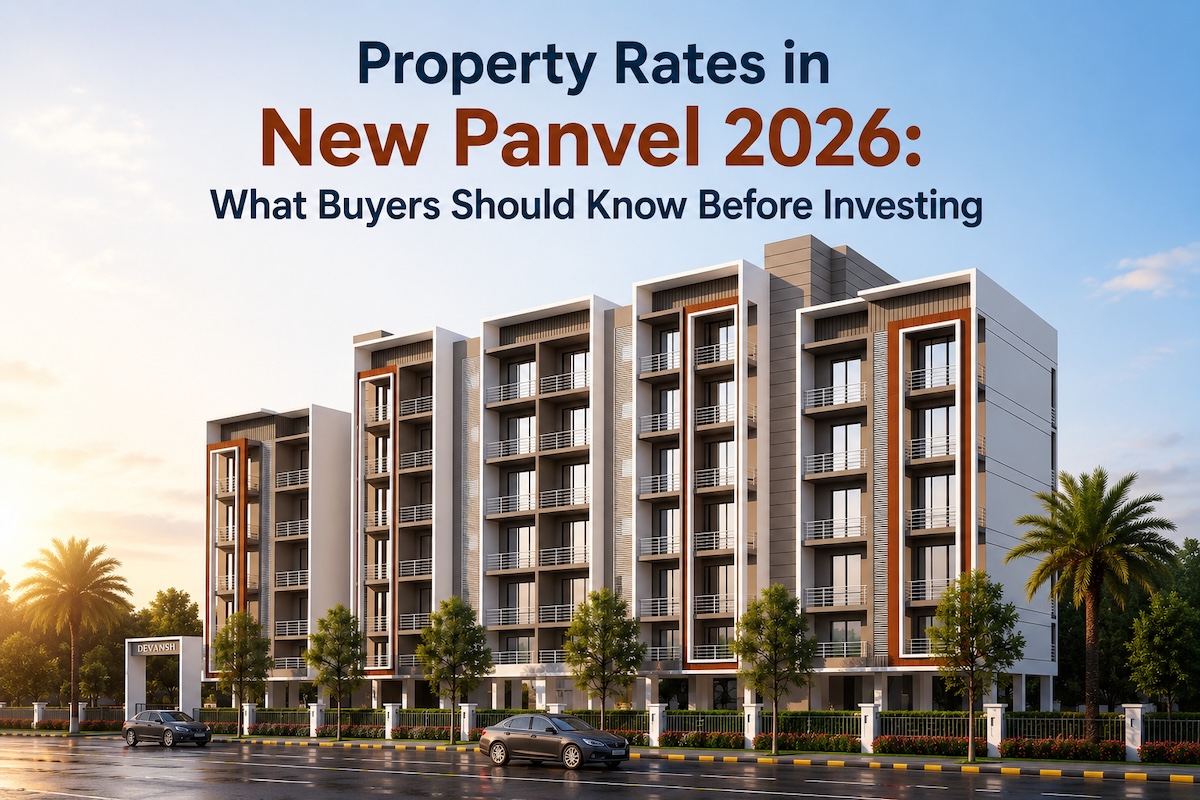
New Panvel has moved from being a value alternative to Panvel proper to being a destination in its own right — and its pricing in 2026 reflects that shift. If you’re evaluating property rates here before investing, the number on a listing matters less than understanding what’s driving it and whether that trend has room to continue.
What’s pushing rates up
- Direct road and rail connectivity to Panvel Railway Station, shortening what used to be a longer commute from outlying Panvel pockets.
- Proximity to the Mumbai-Pune Expressway and the upcoming Navi Mumbai International Airport corridor.
- A wave of RERA-registered residential development that has improved the area’s civic infrastructure — wider roads, planned drainage, organised layouts — compared to a decade ago.
- Growing commercial and social infrastructure, including malls, hospitals, and schools, reducing the need to travel to Panvel proper or Kharghar for daily needs.
How rates compare across configurations
1 BHK homes in New Panvel remain the most accessible entry point for first-time buyers, typically the most competitively priced configuration relative to carpet area in the wider Navi Mumbai market. 2 BHK units, the most actively traded configuration in the area, sit at a mid-range price point that reflects steady demand from young families. 3 BHK homes carry a premium but remain notably more affordable than comparable configurations in Nerul or Vashi, which is part of why families upgrading from a 1 or 2 BHK elsewhere in Navi Mumbai are increasingly looking at New Panvel.
At TPV Vishwakarma, this spread is visible across two New Panvel projects. Devansh, in Khanda Colony, offers 1 and 2 BHK homes at accessible price points for first-time buyers and young families. Bharat Enclave offers 2 and 3 BHK configurations for buyers who’ve outgrown a smaller home but still want New Panvel’s value proposition rather than paying a Nerul-level premium for similar space.
Is New Panvel over-priced, fairly priced, or still undervalued?
Relative to Panvel proper, New Panvel still trades at a discount that isn’t fully explained by the marginal difference in commute or infrastructure — which is generally read as a sign that it remains fairly valued rather than over-heated. The bigger question for investors is timing relative to the airport: New Panvel is close enough to benefit from airport-driven demand without carrying the premium that areas closer to Ulwe already command. That combination — meaningful upside exposure at a still-reasonable entry price — is the core argument for buying now rather than waiting.
What to verify before you commit
- The project’s MahaRERA registration number, cross-checked on the official MahaRERA portal.
- Whether the quoted rate is for carpet area or built-up area — this alone can create a 20-25% difference in effective price per square foot.
- Recent registered transaction values in the same sector, not just asking prices from active listings.
- The builder’s track record on delivery timelines, since New Panvel’s fast growth has also attracted less established developers.
How lenders view New Panvel currently
Banks and NBFCs have grown comfortable lending against New Panvel properties, largely because the area’s RERA-registered developments and improving civic infrastructure reduce the perceived risk compared to a few years ago. Loan-to-value ratios here are generally in line with the rest of Navi Mumbai, and approval timelines have shortened as more projects establish clean title and completed documentation. That said, financing terms can still vary meaningfully between an established developer with a long delivery track record and a newer entrant — another reason the builder’s history matters as much as the headline rate per square foot.
Bottom line for buyers
New Panvel in 2026 offers a rare combination for Navi Mumbai: rates that have grown steadily rather than spiked, genuine infrastructure catching up to the growth, and a spread of configurations that suits both first-time buyers and upgrading families. The fundamentals support continued appreciation, but as with any growth corridor, the returns favour buyers who verify the paperwork rather than buying on price momentum alone.
Ready to see these homes in person? Visit the TPV Vishwakarma experience centre at CBD Belapur, Navi Mumbai, or call +91 9619967000 to book a free site visit.